About
Hormones directly affect endurance, recovery, energy levels, menstrual cycle, and overall well-being. This check-up helps to evaluate sex hormone balance, pituitary function, and identify possible disorders that may influence sports performance, mood, and quality of life.
What's included
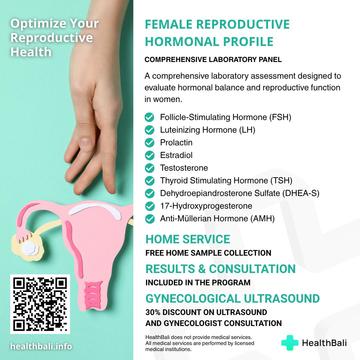
Regulates ovulation and progesterone production. Abnormal levels may indicate disruptions in the menstrual cycle or ovulatory function.
Controls follicle growth in the ovaries. Elevated levels may suggest reduced ovarian reserve.
Elevated prolactin can cause cycle irregularities, infertility, decreased libido, and general fatigue.
Important for the second phase of the menstrual cycle and implantation. Low levels may lead to PMS, sleep disturbances, and fertility issues.
The main female estrogen. Regulates the menstrual cycle, supports bone mass, and influences mood and energy.
Provides an overall picture of estrogen levels in the body. Useful for evaluating hormonal balance.
Used to rule out congenital adrenal hyperplasia and to assess androgenic activity.
An adrenal androgen that may influence energy levels, libido, and muscle mass.
The program can be adapted to your cycle, goals (sports, reproductive, recovery), and age. Additional tests – such as testosterone, SHBG, or other markers – can be included if needed.
💬 You can discuss with your physician which markers will be most informative for you.
- Free home visit
- Online consultation or in-person visit with a physician for result assessment and development of further treatment or prevention strategy
- Personal online manager support at all stages of the check-up
Bruising (hematoma) after a blood test
Blood collection is a routine procedure, but it may sometimes cause bruising at the puncture site.
During venous blood collection both the skin and the vein are punctured. When the needle is removed, blood can leak into the surrounding tissue – especially if the pressure in the vein is high – and a hematoma (bruise) may form.
Contributing factors include the body's physiological and anatomical features: the condition of the veins and vessels, their thickness and elasticity, position and visibility.
How to avoid bruising
- Press firmly on the puncture site for 5–10 minutes.
- Keep the plaster on for at least 30 minutes.
- Avoid straining the arm – don't lift anything heavy for an hour and don't drive for the first 15–20 minutes after the draw. Even minor activity can lead to extensive bruising and swelling around the site.